|
Click
on picture for pause
|
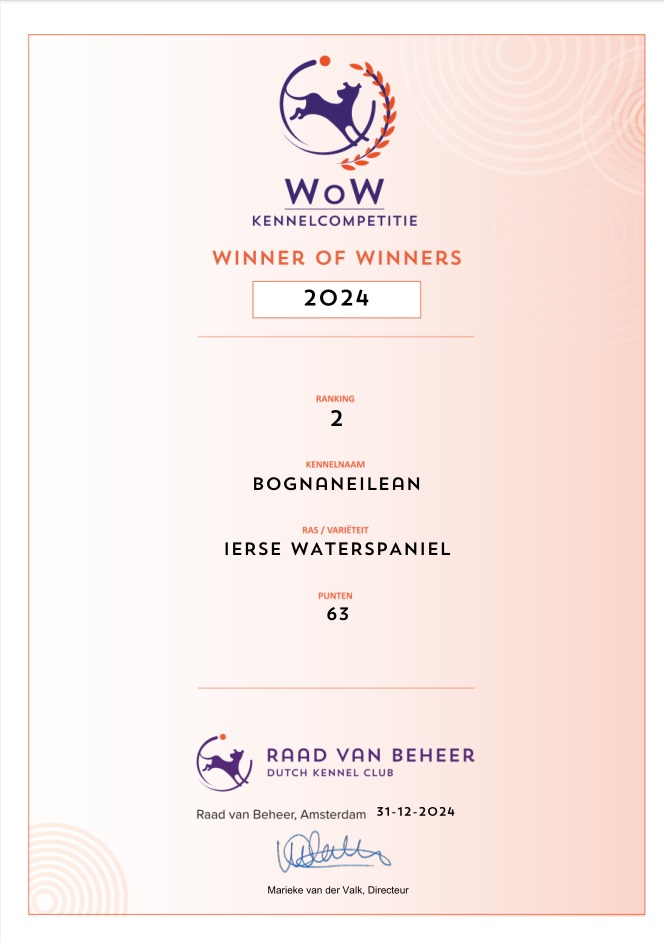
Bognaneilean
Irish Water Spaniel

BognaneileanIrish Water Spaniel
|
|
 HOW TO RECOGNIZE A PEDIGREE DOG
Many people associate a pedigree dog with a familiar name and a
recognizable appearance. Yet, in the Netherlands, only 20–25% of
all dogs are actually pedigree dogs with an official pedigree. The rest
are crossbreeds or dogs that resemble a breed but aren't formally
classified as such. This means that physical resemblance or a breed
name alone, says little about what a dog actually is.This isn't necessarily right or wrong, but it is important to know what you're getting. A dog's origins often reveal something about its health, temperament, hereditary risks, and the care it needs. That's precisely why the distinction between a pedigree dog and a dog that merely resembles a breed is relevant. A dog is only considered a pedigree dog when its lineage can be demonstrably documented with an official pedigree from a recognized Kennel club. You don't recognize a pedigree dog by its appearance or name, but by its origins. This registration provides insight into whether multiple generations of parent dogs belong to the same breed and have been bred within the established breed standard. This offers no guarantees, but it does provide transparency about the background and breeding methods. In practice, however, breed names are often used as a collective term for dogs that resemble a breed, regardless of whether their origins are established. As a result, non-breed-typical dogs or even crossbreeds are also classified under a breed name, which can give a distorted picture of what a breed actually is. Physical characteristics, temperament and breeding quality can vary significantly outside of controlled breeding. ©Weetwatjekoopt.nl
Mobile: +31(0)6 14418596 +31(0)6 51413910
|
||||||||||||||||


 IWSVN
IWSVN